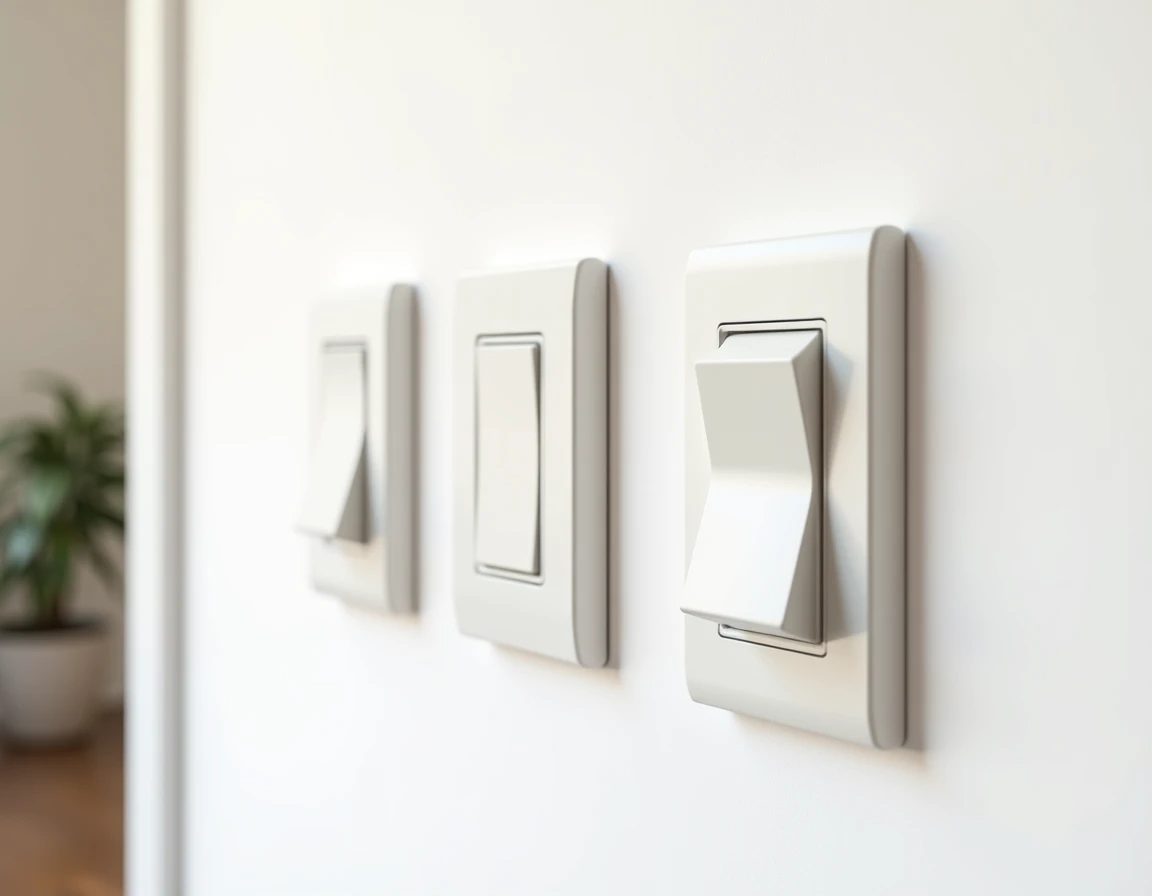
Legrand dominates the French market for electrical devices with three ranges that cater to very different logics: Céliane, Mosaic, and Neptune. Choosing between them is not just a matter of taste or budget. The format of the mechanism, the type of installation planned, and the capacity for future upgrades guide the choice long before the color of the plate.
Modular format and future compatibility of the electrical installation

The least visible criterion at the time of purchase, yet the most structuring, concerns the physical format of the mechanism. Mosaic is based on a standard module of 45 x 45 mm, designed to fit into conduits, technical columns, and standardized boxes. This format makes each position modular: you can replace a simple switch with an RJ45 socket, a USB charger, or a lighting control module without changing the support.
Céliane uses a proprietary Legrand format, different from 45 x 45. The mechanisms clip onto a dedicated support, which is itself fixed in a Batibox flush-mounted box. The range of connected functions is more developed here (dimmers, wireless controls, Netatmo home automation scenarios), but everything remains within the Céliane ecosystem. Adding a tertiary function like a multimedia socket or presence detector requires checking the availability of the mechanism in this specific format.
Neptune, recently repositioned by Legrand as the “improving the essentials, simply” range, targets common residential renovations. Its catalog of functions remains deliberately limited. Before committing to this range, it should be noted that Neptune does not offer native home automation modules and that later adding advanced functions will likely require a change of range, thus changing supports and plates.
For those considering adding home automation, multimedia sockets, or tertiary functions without completely replacing everything, it is useful to compare Legrand switches taking this capacity for evolution into account, not just the price at the control point.
Legrand Céliane switch: finishes and residential connectivity
Céliane stands out for the clear separation between mechanism, support, and finishing plate. This composable architecture allows for changing the cover of a switch or socket without interfering with the wiring. The plates come in white, titanium, and decorative materials (metal, wood, leather), positioning Céliane as the range for residential customization at Legrand.
Integration with the connected Legrand ecosystem (compatible with Netatmo) is another strong point. Wireless control mechanisms, connected dimmers, and scenario switches are natively available in the Céliane format. It is the only one of the three ranges that offers a complete residential home automation catalog without resorting to external modules.
However, this richness comes at a cost. The price per control point exceeds that of Mosaic and Neptune, and the customization of plates further increases the bill. For a new home or a high-end renovation, the additional cost is justified by aesthetic and functional flexibility. For a rental investment or a quick renovation, the question deserves to be asked.
Mosaic in tertiary and residential: the 45 x 45 standard
Mosaic is the reference range in the tertiary sector, and this is no coincidence. The 45 x 45 mm format is a standard shared by other manufacturers, ensuring interoperability of supports and conduits. In an office, school, or public establishment, Mosaic allows for concentrating multiple functions on the same position thanks to its native modularity.
The range includes over 500 references, covering functions that neither Céliane nor Neptune offer: high-density computer sockets, controls for blinds, technical detectors. In residential settings, Mosaic remains relevant in specific configurations:
- Installation with visible conduits (renovation without chases), where the 45 x 45 format naturally imposes itself
- Mixed-use spaces (residential with integrated professional office) requiring tertiary functions on certain positions
- Projects anticipating an evolution towards multimedia or access control functions
Finishes remain limited, primarily in white. Mosaic is not designed for interior decoration, and the visual rendering in surface-mounted or conduit installations does not suit all residential interiors.
Neptune: current positioning and limitations for renovation
Neptune has long been perceived as simply Legrand’s entry-level range, a functional device without aesthetic ambition. Since its repositioning, the range features a modernized design and simplified installation, aimed at common renovations sold in DIY superstores.
Neptune is gradually replacing the old basic series in GSB shelves (Castorama, Leroy Merlin). The intended compromise is clear: a contained price, a contemporary look, and an installation accessible to individuals. For a like-for-like replacement of aging switches in a home without plans for functional extension, Neptune fulfills its role.
Limitations become apparent as soon as one considers an upgrade. The catalog of mechanisms is limited to basic functions (simple switches, two-way switches, 2P+T sockets). No connected dimmer, no integrated RJ45 socket, no scenario module. An individual installing Neptune today who wishes to add home automation in three years will need to change the entire position: mechanism, support, and plate.
Comparative table of Céliane, Mosaic, and Neptune
| Criterion | Céliane | Mosaic | Neptune |
|---|---|---|---|
| Main use | High-end residential | Tertiary, collective, technical residential | Common residential renovation |
| Module format | Proprietary Legrand | Standard 45 x 45 mm | Simplified proprietary |
| Decorative finishes | Wide choice (metal, wood, leather, colors) | Mainly white | White, sober contemporary design |
| Native home automation | Yes (Netatmo ecosystem) | Advanced tertiary functions | No |
| Scalability of the position | High (interchangeable mechanisms) | Very high (modularity 45 x 45) | Low |
| Distribution | Specialized distributors, e-commerce | Professional distributors | GSB (Castorama, Leroy Merlin) |
The choice between these three ranges commits the installation for several years. Changing ranges midway means replacing supports and plates, not just the mechanism. Anticipating functional needs in the medium term, especially in home automation or multimedia connectivity, avoids costly rework on a project thought to be finished.