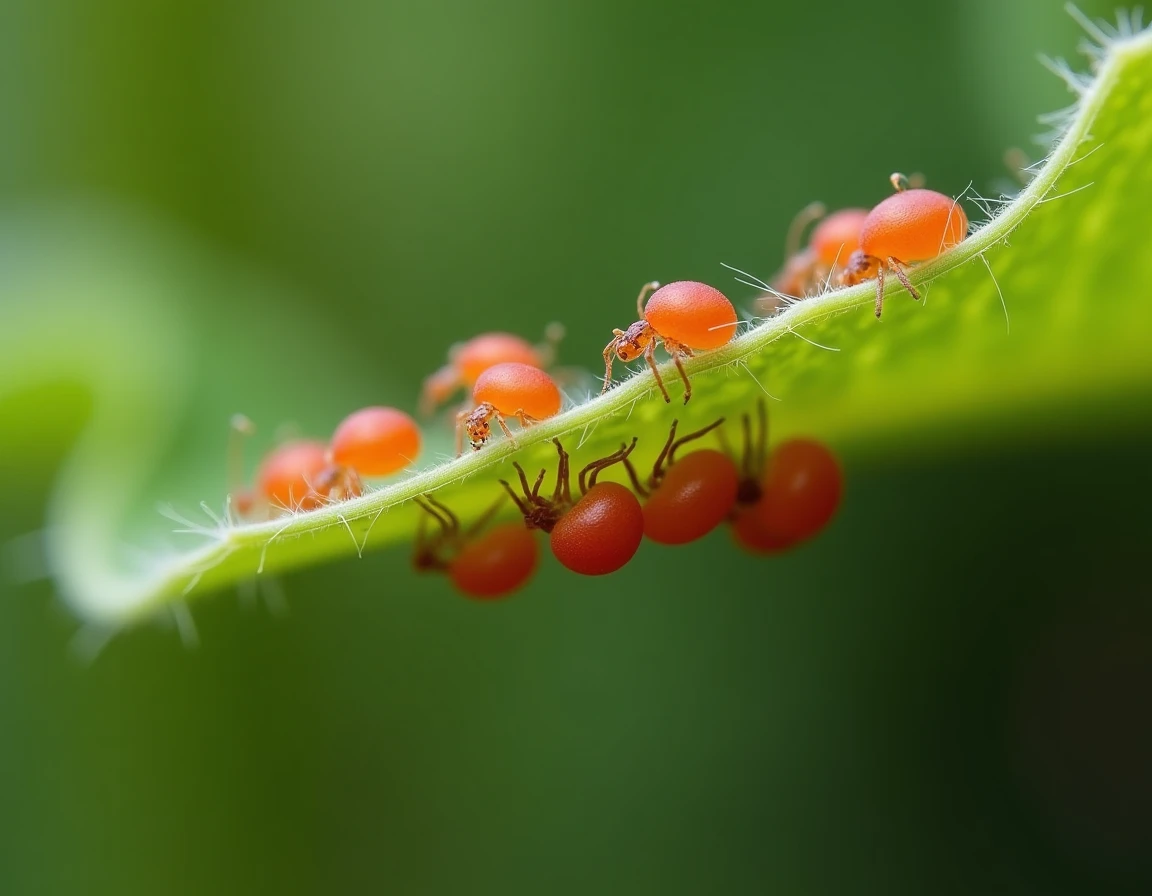
The term “little red bugs” encompasses at least three families of mites with radically different lifestyles. Some feed on sap, others hunt aphids, and still others do not touch plants at all. Treating without distinguishing these species amounts to eliminating beneficial organisms that naturally regulate garden pests.
Garden red mites: three species, three distinct roles

The confusion starts with color. A tiny red dot moving on a leaf, a wall, or a patio slab is almost always reflexively classified as a “red spider.” The problem is that this label groups organisms with opposing functions in the garden ecosystem.
The spider mite (Tetranychus urticae) is the only true pest in the group. This plant-feeding mite pierces plant cells to suck out their contents. It measures about 0.5 mm and, despite its name, often appears yellow or gray-green. It only becomes distinctly red under certain conditions.
Predatory mites, such as those from the genus Balaustium, are bright red. They move quickly on mineral surfaces and hunt the eggs of harmful insects as well as young aphids. Their presence on a terrace or wall is a sign of a healthy garden, not an infestation. Field observations in urban ecology confirm their role as biological control agents.
The third group: Bryobia, small dark red mites that often appear in masses on facades in spring. They feed on micro-algae and lichens, not cultivated plants. Their presence, even if spectacular, does not warrant any treatment in the vegetable garden.
Before reacting to little red bugs in the garden, the first useful step is to observe their behavior: a stationary mite under a leaf, associated with fine webs, has nothing to do with a bright red dot running on the stone.
Identifying a spider mite on plants
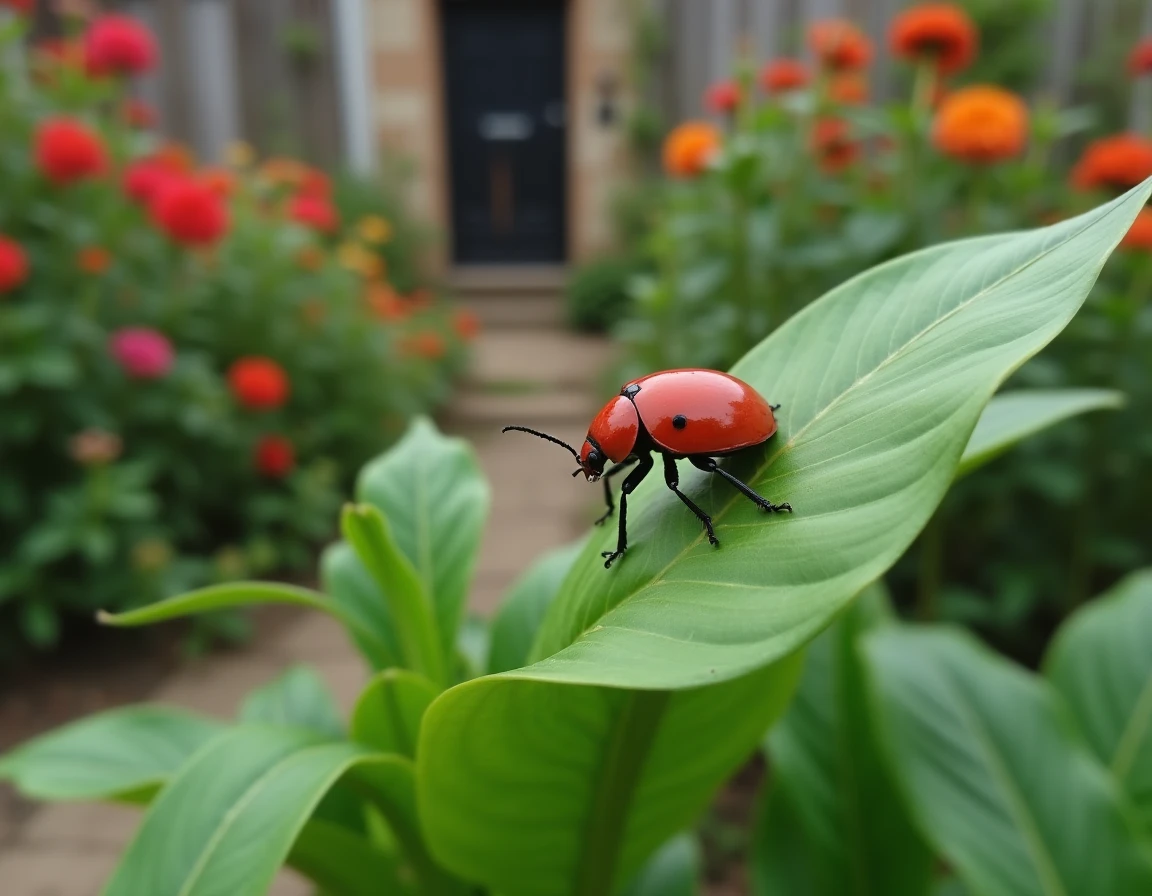
The spider mite is the only red mite in the garden that deserves targeted intervention. However, one must know how to spot it, as it is almost invisible to the naked eye.
Signs on the foliage
The first symptoms appear on the underside of the leaves. Tiny discolored spots, yellow or silver, multiply along the veins. The foliage takes on a dull, dusty appearance.
As the colony grows, fine, silky webs connect the leaves or accumulate at the junction of the stems. These threads do not resemble typical spider webs: they form a tight, almost translucent veil. This is the most reliable sign to distinguish the spider mite from harmless mites.
Favorable conditions
- Warm, dry air accelerates the reproduction of the spider mite. Prolonged drought episodes, increasingly frequent in recent years, promote outbreaks.
- Plants stressed by insufficient watering or depleted soil are the first to be affected. The pest settles first where the plant is weakened.
- Greenhouse crops or those against a south-facing wall concentrate heat and low humidity, two factors that directly benefit the spider mite.
A often underestimated point: a spider mite outbreak first signals an imbalance in the microclimate, not a fatality. Organic vegetable farming extension services emphasize this direct link between water stress and population explosions.
Correcting the environment before treating harmful mites
Spraying black soap or an acaricide, even of natural origin, on a garden where the underlying problem is overly dry soil and an unbalanced microclimate produces temporary results. The colony returns as soon as conditions become favorable again, often within a few weeks.
The first correction concerns water. Regular watering at the base of sensitive plants (tomatoes, eggplants, beans, roses) maintains ambient humidity that the spider mite poorly tolerates. Spraying the foliage in the late afternoon significantly reduces pest pressure without any product.
Plant diversity also plays a direct role. A monoculture vegetable garden offers a buffet without predators. Interspersing aromatic plants, allowing some weeds to flower at the edges of the plot, and maintaining bare soil areas allows predatory mites to establish themselves sustainably.
Partial shading is an underutilized lever. A simple shade cloth placed during the hottest hours, or associated crops grown tall (sunflowers, corn), lowers the temperature by several degrees at the leaf level. This differential is enough to slow the spider mite’s reproduction cycle.
Beneficial mites and climate change: a dynamic to monitor
The early heat episodes observed since 2022 have led to a notable increase in observations of non-harmful red mites (Balaustium, Bryobia) in gardens. These species benefit more from warming than phytophagous spider mites, making confusion between the two groups even more frequent.
Systematically eliminating everything that is red and tiny amounts to destroying the predators that naturally limit true pests. Experiences in permaculture document that plots where predatory mites are preserved suffer fewer attacks from aphids and thrips without any additional treatment.
- Balaustium mites actively hunt pest eggs on mineral surfaces near crops.
- Some predatory soil mites participate in the decomposition of organic matter and the regulation of nematodes.
- Their presence in numbers on a terrace or wall indicates an environment rich in microfauna, favorable to neighboring crops.
The reflex of total eradication, inherited from a view of the garden as a sterile space, deprives the soil and plants of free and effective regulators. Maintaining a population of non-harmful red mites incurs no cost and provides measurable service.
Thus, the question is not whether these red bugs are bothersome, but which one, among the three families present in an ordinary garden, actually poses a problem. In the majority of cases, the answer is: only one, and only when the environment is too favorable for it.