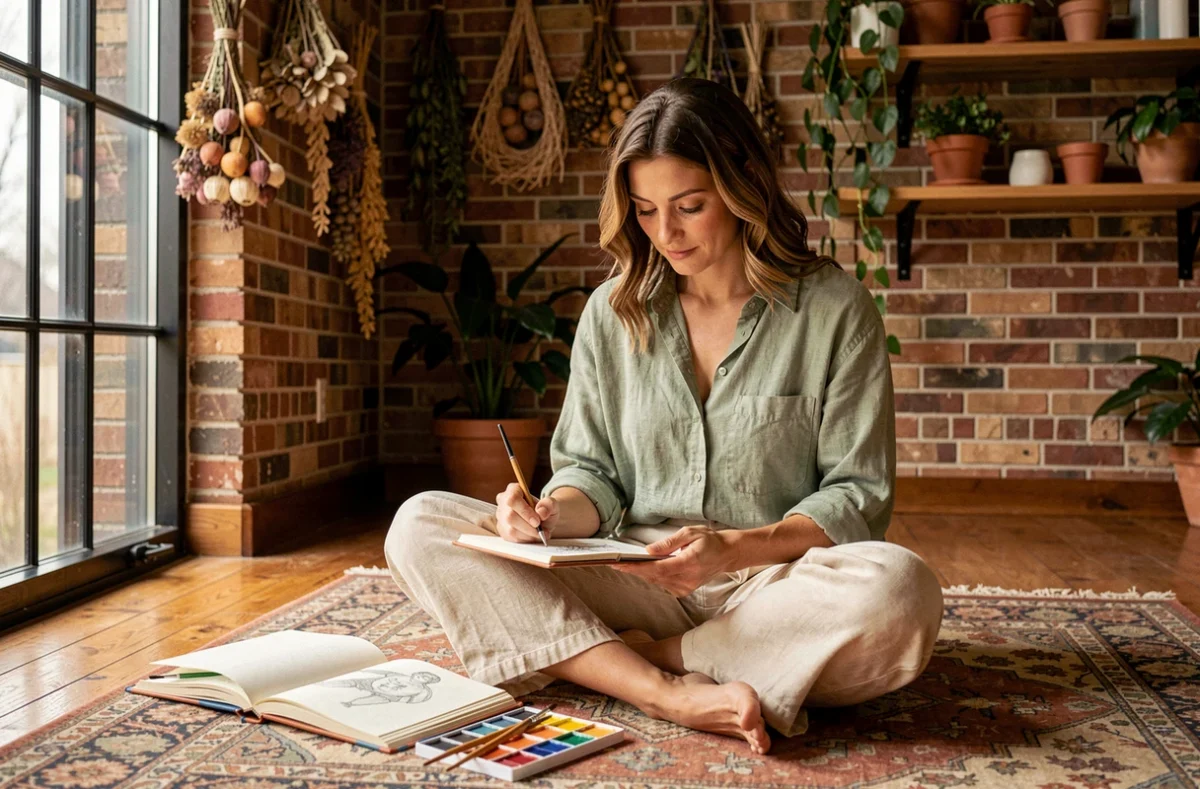
Creativity refers to the ability to produce new associations between existing ideas, gestures, or materials. Serenity, on the other hand, refers to a state of inner calm that does not depend on the absence of constraints, but on how one copes with them. Connecting these two concepts in daily life requires understanding their respective mechanisms before articulating them.
Creative Micro-Rituals: Anchoring a Practice Without Overloading the Schedule
A creative ritual does not need to last long to have an effect. A few minutes of free drawing in the morning, an improvised recipe with what’s left in the pantry, a notebook where one notes three unusual observations of the day: these short gestures activate a divergent mode of thinking.
What distinguishes a creative micro-ritual from a simple distraction is the regularity and intention. Repeating a creative gesture at a fixed time, even briefly, creates a routine that eventually functions as a signal of mental availability. The brain associates this moment with a space of freedom, which facilitates entering a state of relaxed concentration.
Blogs and magazines specializing in creative hobbies often offer accessible ideas to get started. Chez Sylvie, for example, gathers concrete inspirations for integrating creativity into an already busy daily life. The goal is not to become an artist, but to allow oneself a regular space for play.

Right to Disconnect and Serenity: The French Legal Framework That Wellness Advice Ignores
Most articles on daily serenity recommend “turning off screens in the evening.” The advice seems simple. It overlooks a structural obstacle: the professional pressure that pushes one to remain reachable at all times.
In France, since January 1, 2017, concerned companies must negotiate the terms of the right to disconnect. In the absence of an agreement, a charter must specify the measures for regulating digital tools and the actions to raise employee awareness. This regulatory framework, enshrined in the Labor Code, provides a concrete lever that purely individual approaches do not mention.
Recent case law distinguishes voluntary access to professional tools from the pressure exerted by the employer. This nuance changes the game: turning off one’s phone is not enough if the workload remains excessive. A disconnection charter can remain a dead letter when the set objectives push employees to work outside of hours.
Transforming the Right to Disconnect into a Personal Habit
Knowing this right allows one to set limits without guilt. Concretely, this can translate into simple actions:
- Disable professional notifications after the end of the workday, relying on the company charter if it exists.
- Report to one’s manager or the CSE any situation where disconnection is made impossible by the workload.
- Use the freed-up time for a creative ritual or an activity of full presence, rather than replacing a professional screen with a leisure screen.
Daily serenity is not just a matter of personal discipline. It also depends on organizational conditions that French labor law recognizes.
Creativity and Generative Tools: Preserving Originality in the Face of AI
The rise of generative artificial intelligence tools (image, text, music generation) is changing the relationship to creation. These technologies facilitate production but raise a tension: if a machine can generate a visual or a poem in seconds, what meaning is left in creating oneself?
The manual creative gesture retains a distinct psychological function. Drawing, modeling, writing by hand, or cooking engages the body in a slow process that mobilizes attention differently. This deliberate slowness produces a centering effect that automatic generation does not provide.
Recent surveys, particularly those by Ipsos on youth, highlight a growing concern regarding the role of AI in creative practices. The question is not to reject these tools, but to distinguish assisted creation from embodied creation. Using an image generator to explore visual avenues, then taking the work back to hand: this alternation preserves personal engagement while leveraging technology.

Meditation and Art: Two Complementary Practices
Mindfulness meditation and artistic practice share a common mechanism: they bring attention back to the present moment. Meditating for a few minutes before drawing or writing helps reduce self-censorship, that frequent obstacle that blocks creative momentum.
This complementarity does not require any particular skill. Five minutes of attention to breathing, followed by ten minutes of free drawing, is enough to create a coherent sequence. The mind shifts from a state of calm receptivity to a state of open production, without a jarring transition.
Creative Routine and Serenity: Building a Sustainable Daily Life
A routine only works if it remains sustainable. Scheduling an hour of painting every evening when coming home exhausted from work is setting up for failure. Daily creativity relies on adaptable formats.
The guiding principle is flexibility of format, not intention. If the evening slot is missed, a notebook slipped into a bag allows for doodling during a break. If fatigue prevails, listening to a podcast about art or flipping through a picture book also counts as creative nourishment.
The most durable habits are those that fit into the empty spaces of the day rather than those that require reorganizing the schedule. Waiting in line, taking public transport, waiting before an appointment: these moments become windows for micro-creation or active contemplation.
Serenity cannot be decreed by a list of resolutions. It emerges when material conditions (right to disconnect, reasonable workload) and personal practices (creative rituals, full presence) converge. The regularity of a small creative gesture better protects inner calm than a large project abandoned after two weeks.